
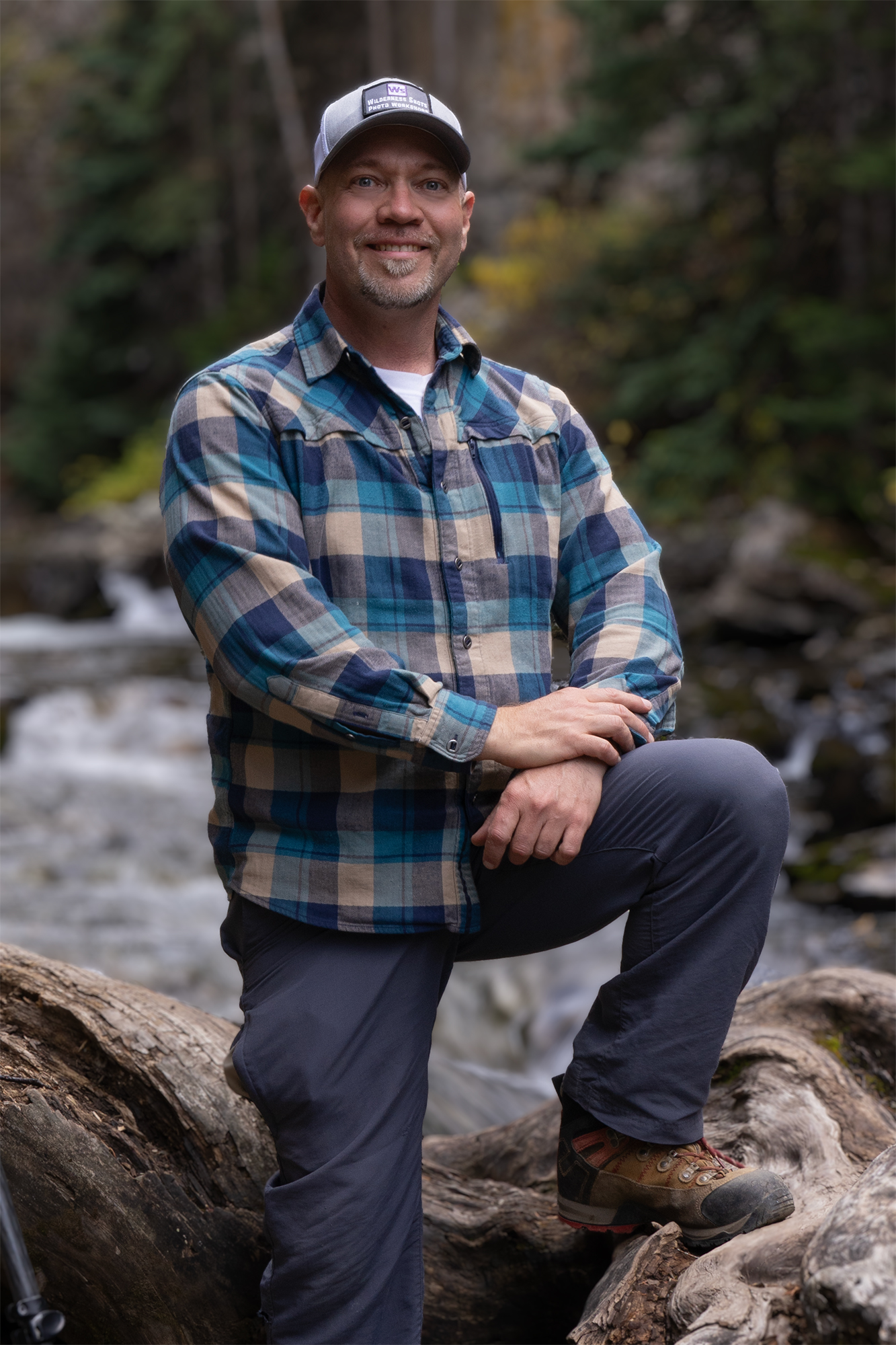
I’m a producer of nature documentaries and photographer of the Rocky Mountains. It’s not that I intended to be either, but I have a compulsion to record everything beautiful that I see. When I was a kid I liked to wander through wild
places in search of strange creatures and epic scenery. I saw enough amazing things, that when I was a teenager my dad gave me a vintage Canon to capture it all. That old film camera with not even so much as auto-focus taught me the right way to make photographs. For me, photography evolved from mere documentation to art. I grew up in New Jersey, Missouri, and Germany. A trip to the Rockies when I was 16 forever infused me with the desire to live there. A few years later, I joined the Army and they sent me on some exciting assignments out west. Once, in the Utah desert they booted me off the back of a
truck with a map and compass and told me to navigate back home. As I wandered through that red expanse flanked by giant mountains, it was settled that I must head west.
That would happen right after college. I studied my passion, Wildlife Biology, at the University of Missouri. After that, I threw what I owned in my pickup and headed to Colorado in search of adventure. Those adventures would take the form of chasing beautiful scenes with a camera and recording the dramas of nature through video. Today, the adventures continue and I live in my favorite place, Fort Collins, Colorado. Recent developments in HD technology and in-camera video have allowed me to produce my own films about interesting ecosystems and wildlife. You can also check out my back country photography gear.
One of my biggest ecological concerns is an amphibian plague that’s sweeping across the planet and eradicating entire amphibian species in as quickly as a few months. It’s called “Chytrid” and over 160 amphibian species have been lost in only the past three decades to Chytrid and compounding factors. Spread by human activities, Chytrid is a fungus that spreads through water systems, is transmitted between animals, and can survive in the soil. Once embedded upon a susceptible amphibian, the skin thickens, proper respiration and hydration are impeded, and the animal dies. As Chytrid sweeps through new areas, it kills susceptible amphibians who have no defense against the exotic pathogen. In Colorado, the Boreal Toad is a notable species affected by Chytrid. We don’t know how to stop Chytrid yet. There are critically endangered species with too few individuals left to survive, which will soon be extinct unless we act. In addition to research, our only hope is to preserve breeding colonies of dwindling species in captivity, which may be reintroduced to the wild after a solution has been found. This is what my friends at Amphibian Ark do. Please visit them and watch this video to find out more.